About
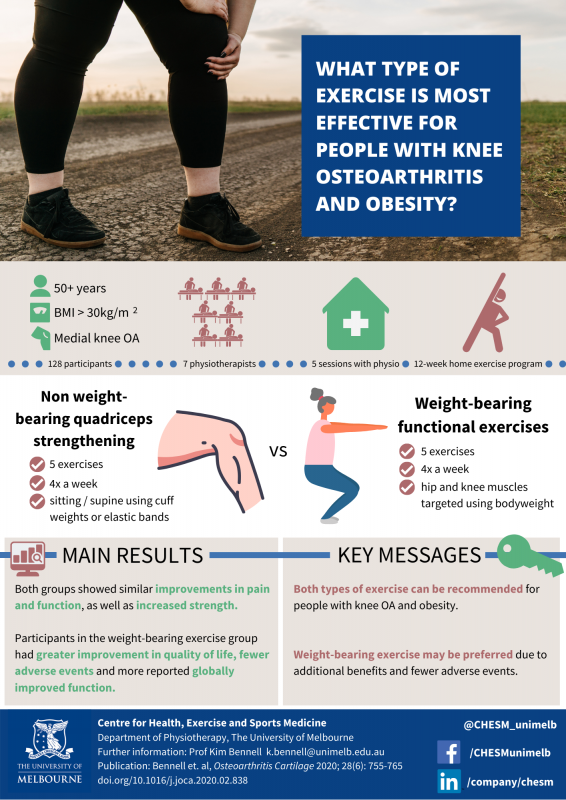
The primary aim of this study was to investigate two home-based strengthening programs (weight bearing functional exercise versus non-weight bearing quadriceps strengthening exercise) amongst people with knee osteoarthritis and obesity. Exercise is recommended for management of OA, yet very little is known about how people with osteoarthritis and obesity may respond to different exercise programs.
Status of project: completed
Publications
What type of exercise is most effective for people with knee osteoarthritis and co-morbid obesity?: The TARGET randomized controlled trial
Comparison of weight bearing functional exercise and non-weight bearing quadriceps strengthening exercise on pain and function for people with knee osteoarthritis and obesity: protocol for the TARGET randomised controlled trial
Researchers involved in this study included Prof Kim Bennell, Prof Rana Hinman, Tim Wrigley, Sarah Schwartz, Alex Kimp, Ben Metcalf and Rachel Nelligan at the University of Melbourne with collaborators at Monash University and University of Queensland. The study was funded by the National Health and Medical Research Council.
See our other research summaries
-
Internet-mediated physiotherapy and pain coping skills training for persistent knee pain (IMPACT)
This randomised controlled trial investigated the effects of a pain coping skills training with physiotherapy-guided home exercise, delivered via the internet, on knee osteoarthritis symptoms.
-
Modified Yoga Exercise (COPE)
This randomised controlled trial compared the effects of online education to a modified yoga exercise program for managing osteoarthritis symptoms.
-
Better Knee Better Me
This randomised controlled trial compared remotely-delivered interventions targeting exercise and self-management, exercise and active weight management, or information-only for people with knee osteoarthritis and overweight.
-
platelet-Rich plasma as a symptom- and disEaSe-modifying Treatment fOR knee ostEoarthritis (RESTORE)
This randomised controlled trial aimed to find out whether a series of three PRP injections into the knee joint was effective in reducing pain and slowing loss of cartilage
-
CHESM-NDIS Study
A national survey to investigate the experiences of NDIS participants, or their family members/carers, when accessing care during the COVID-19 pandemic.
-
Allied Health Telehealth
A national survey to investigate the experiences of allied health clinicians and clients when accessing care via telehealth during the COVID-19 pandemic.
-
My Knee Exercise
This randomised controlled trial assessed the effectiveness of a novel self-directed web and mobile phone based exercise program on knee osteoarthritis symptoms.
-
Footwear for self-managing knee osteoarthritis symptoms (FOOTSTEP)
This randomised controlled trial compared the effects of two different types of shoes on knee osteoarthritis symptoms.
-
Telehealth by physiotherapists in Australia during the COVID-19 pandemic
This study aimed to gather information to help in decision making around future funding of telehealth services by physiotherapists once the pandemic has ended.
-
Osteoarthritis Information Video
This study evaluated the responses of people with knee osteoarthritis to a brief educational video about their condition created to empower and motivate effective self-management
-
Comparative effect of two educational videos for people with knee osteoarthritis (vidEO)
This randomised controlled trial compared the effect of two knee osteoarthritis educational videos on people with knee osteoarthritis for self-efficacy and fear of movement.
-
Online Support Group for people with knee osteoarthritis
This study investigated whether it is feasible to conduct a fully powered RCT on an Online Support Group intervention for people with knee osteoarthritis symptoms
-
Shoes for Knee Pain (FOLK)
Comparing the effects of two types of readily available off-the shelf walking shoes on knee osteoarthritis symptoms in lateral compartment osteoarthritis
-
Core capability framework for health professionals to optimise care for people with osteoarthritis
This study aimed to determine the core capabilities required for qualified health professionals to optimise care for people with osteoarthritis.
-
Physiotherapist and patient experiences alignment with Australian Knee Osteoarthritis Clinical Care Standards
These studies assessed the experiences of physiotherapists and patients and their alignment with knee osteoarthritis clinical care standards.
-
Telephone-delivered support and advice for people with knee osteoarthritis (TELECARE)
This randomised controlled trial compared two different forms of telephone delivered support and advice for people with painful knee osteoarthritis
-
Musculoskeletal pain treatment pathways (PACE)
This study is comparing the treatment pathways provided in primary and specialist care to advance understanding of recovery from musculoskeletal conditions
-
Behaviour change SMS program for knee osteoarthritis (ADHERE)
This randomised controlled trial compared the effectiveness of a 24-week behaviour change SMS program to no SMS for patients with knee osteoarthritis and obesity.
-
Exercise for knee osteoarthritis targeting high risk physical characteristics (TARGET)
This randomised controlled trial aims to compare two types of home exercise programs for people with knee osteoarthritis and obesity.
-
Arthroscopic Surgery for Hip Impingement versus Best CoNservative Care (FASHIoN)
This randomised controlled trial aims to compare the clinical and cost effectiveness of hip arthroscopy with Personalised Hip Therapy for patients with symptomatic FAI up to 12 months after treatment.
-
Impact of Cane Use in people with medial knee osteoArthritis (CUBA)
This randomised controlled trial evaluated the effects of daily cane use on knee osteoarthritis symptoms.
-
Modified SHoes for osteoARthritis of the Knee (SHARK)
This randomised controlled trial tested the efficacy of “modified” shoes for reducing symptoms and improving physical function in people with knee osteoarthritis
-
LatErAl hiP pain (LEAP)
This randomised controlled trial compared the effects of three possible approaches to treating long standing lateral hip pain
-
Insoles for Big Toe Osteoarthritis (FORT)
This randomised controlled trial is comparing the effects of insoles on big toe osteoarthritis symptoms.
-
Internet-based pain coping skills training added to education and exercise program for persistent hip pain (HOPE)
This randomised controlled trial investigated the effects of adding an internet-based pain coping skills training to a standardised education and exercise program for people with persistent hip pain
-
Influence of athletic footwear on lower limb biomechanics of pubertal girls
This study aimed to determine whether athletic footwear with appropriate design features can help improve neuromuscular control and reduce forces on the knee and lower limb of pubertal girls
-
Optimising primary care management of knee osteoarthritis (PARTNER)
This randomised controlled trial evaluated a model of care for primary care management that supports both General Practitioners and patients to uptake knee osteoarthritis clinical guideline recommendations
-
Patient AdhereNce To Home Exercise pRograms (PANTHER)
This randomised controlled trial evaluated whether the addition of a web-based system, Physitrack, to usual physiotherapy treatment improves patient adherence to exercise compared to the usual non web-based methods.
-
Assessment of Beliefs and Clinical practice for Foot Osteoarthritis (ABC-Foot)
This study aimed to describe podiatrists' and physiotherapists' current management of people with foot osteoarthritis within Australia and the United Kingdom.
-
Hip Osteoarthritis Pain Exacerbation risk factors (iHOAP)
This study is designed to identify risk factors of hip pain and assess their magnitude of effect in those with hip osteoarthritis.
-
Knee bracing and footwear for medial knee arthritis
This study evaluated the effects of a knee brace and different types of shoes on knee osteoarthritis symptoms.
-
Treatment of foot pain and osteoarthritis
The study evaluated different treatments for foot osteoarthritis
-
Fear of ACL reinjury
This study compared fear and certainty of reinjury between follow up time points and three treatment groups following surgical and nonsurgical management of ACL injury.
-
Exploring factors for osteoarthritis after ACL injury
This study examined factors for osteoarthritis onset following anterior cruciate ligament (ACL) injury
-
Digital health technologies in musculoskeletal physical therapy
This study examined frequency and willingness of digital health use before the COVID-19 pandemic among physical therapists and patients with musculoskeletal conditions
-
Guidance for therapeutic exercise implementation
This study examined current literature informing implementation of therapeutic exercise for patients with hip and knee osteoarthritis
-
e-Learning on physiotherapists' confidence in weight management
This randomised controlled trial evaluated the effects of e-Learning program on physiotherapists' confidence in weight management for people with osteoarthritis
-
e-Learning for physiotherapists to manage knee osteoarthritis via telehealth
This study examined the real world reach, effectiveness, adoption and implementation of an e-Learning program developed for physiotherapists to manage knee osteoarthritis via telehealth during the COVID-19 pandemic
-
Physiotherapists’ experiences of an e-learning for knee osteoarthritis management
This study explored physiotherapists’ experiences with and perceptions of an e-learning program about best practice knee osteoarthritis management.
-
Ankle sprains in netball
This study examined the current ankle sprain prevention and management strategies of netball athletes literature and compared with best-practice recommendations.
-
Walking-related knee contact forces and knee pain
This study examined the associations between walking-related knee contact and knee pain amongst different radiographic grades of knee osteoarthritis.
-
Educational information, with and without pathoanatomical information, for people with knee osteoarthritis
This randomised controlled trial compared the effect of educational information, with and without pathoanatomical information, for people with knee osteoarthritis
-
Confidence of Australian physiotherapy students and recent graduates delivering care via videoconferencing
This study examined the confidence of Australian physiotherapy students and recent graduates delivering care via videoconferencing
-
What is the difference between hip and knee osteoarthritis?
This review highlights the differences between hip and knee osteoarthritis
-
Beliefs about hip pain and its care
This systematic review highlights the beliefs and expectations about chronic hip pain and its care.
-
Healing of acute ACL rupture without surgery: An analysis of the KANON Trial
This study evaluated the natural course of anterior cruciate ligament (ACL) healing on MRI within 5 years of acute ACL rupture.
-
Effects of educational information, plus general practitioner recommendation, on osteoarthritis management beliefs
This randomised controlled trial compared the effects of knee osteoarthritis educational information, plus a general practitioner recommendation to exercise, on people's osteoarthritis management beliefs
-
Telehealth-administered performance-based tests for chronic lower limb musculoskeletal pain
This study aimed to investigate the reliability of performance-based tests via telehealth, and agreement between scores obtained via telehealth and in-person.
-
Telehealth education and training in entry-to-practice physiotherapy programs in Australian universities
This study examined the attitudes and experiences of Australian physiotherapy university educators incorporating telehealth education into entry-to-practice physiotherapy programs
-
Why don't some people with knee osteoarthritis improve with exercise?
This study compared the perceptions of patients about why they did, or did not, respond to a physiotherapist-supported exercise and physical activity program.
-
What should a toolkit to aid the delivery of therapeutic exercise for hip and knee osteoarthritis look like?
This study sought to identify important components of, and practical resources relevant for inclusion in, a toolkit to aid exercise delivery for people with hip/knee osteoarthritis
-
Effects of diagnostic labels and explanations on beliefs about hip pain and its management
This randomised controlled trial aims to compare the effects of diagnoses and their explanations for hip pain on beliefs about hip pain and its treatment.
-
Exploring experiences with online peer support programs for the Fragile X community
This study explored experiences of people with Fragile X syndrome, Fragile X premutation carriers, and their families/carers, with Fragile X-specific online peer support programs
-
Clinical reasoning in managing chronic hip pain
This aim of this study was to explore clinical reasoning in managing chronic hip pain via a case vignette
-
Comparing video to face-to-face consultations with a physiotherapist for people with knee osteoarthritis (PEAK)
This non-inferiority randomised controlled trial compared video to face-to-face consultations with a physiotherapist for people with knee osteoarthritis.
-
Do biomechanical foot-based interventions reduce patellofemoral joint loads in adults with and without patellofemoral pain or osteoarthritis?
This study examined the effects of foot-based interventions on patellofemoral loads in adults with and without patellofemoral pain or osteoarthritis.
-
How does exercise and weight loss diet improve knee pain and physical function?
This study explored the mediators of effects two 6-month telehealth-delivered exercise programs, with and without weight loss diet for pain and physical function improvements in knee osteoarthritis.
-
Exercise for Hip Pain (PHOENIX)
This randomised controlled trial compared the effects of two different 9-month exercise programs on hip osteoarthritis symptoms.
-
Massive Open Online Course (MOOC) for people with hip and/or knee osteoarthritis
This randomised controlled trial evaluated a comprehensive consumer-facing MOOC for people with hip and/or knee osteoarthritis.
-
Exercise and Weight loss for Knee Pain (POWER)
This randomised controlled trial compared the effects of exercise versus exercise and weight loss programs on knee osteoarthritis symptoms and weight loss delivered by physiotherapists.
-
Knee osteoarthritis diagnosis trial
This randomised controlled trial compared the effect clinical osteoarthritis diagnosis and explanation without being sent for x-ray compared to diagnosis and explanation based on x-ray reports (with and without x-ray images).
-
Exercise and Weight loss for Hip Pain (ECHO)
This randomised controlled trial compared the effects of exercise versus exercise and weight loss programs on hip osteoarthritis symptoms.
-
Pain Science Education for knee pain (EPIPHA)
This randomised controlled trial compared the effect of integrating Pain Science Education with individualised education, strengthening and walking program versus individualised program alone for people living with knee osteoarthritis
-
Exploring experiences of people with knee osteoarthritis who received a weight loss diet and exercise program from a physiotherapist
This study explored the experiences of people with knee osteoarthritis undertaking a weight loss diet and exercise program delivered by physiotherapists.
-
Systematic reviews of exercise effects
This series of systematic reviews investigated the effects of exercise for knee osteoarthritis
-
Shoes for Chronic Hip Pain (SCHIPP)
This randomised controlled trial compared the effects of two classes of readily available off-the-shelf shoes on hip pain and osteoarthritis symptoms.
-
Effects of x-ray based diagnosis and explanation of knee osteoarthritis on patient beliefs
This randomised controlled trial aims to determine if the use of x-rays to diagnose and explain osteoarthritis influences people’s beliefs about osteoarthritis management
-
Online Tai Chi for Knee Osteoarthritis (RETREAT)
This study compared the effects of a self-directed 12-week online Tai Chi program plus online education with online education alone on knee osteoarthritis symptoms.
-
How Do Individuals Perceive Diagnostic Labels and Explanations for Hip Pain?
This study aims to examine how adults with hip pain perceive different diagnostic labels and explanations relating to the treatment of hip pain
-
Change in willingness for surgery and risk of future surgery
This study aims to investigate whether becoming unwilling to undergo surgery following an education and exercise intervention is associated with lower probability of actual surgery
-
Entrustable professional activities (EPA) for physiotherapists to demonstrate digital health competency
This study uses an EPA approach to delineate specific activities that demonstrate digital health competency in physiotherapy practice
-
OARSI initiative to develop classification criteria for early-stage symptomatic knee OA (EsSKOA)
This study aims to identify conditions in the differential diagnosis of early stage symptomatic knee osteoarthritis in adults with knee symptoms.
-
Accelerometer-assessed physical activity levels 32–37 years after anterior cruciate ligament rupture — Does initial treatment strategy or the presence of osteoarthritis matter?
This study aims to describe physical activity more than 30 years after acute ACL injury with respect to the WHO physical activity recommendation and to compare physical activity between groups
-
Association Between ACL Continuity on Magnetic Resonance Imaging at 5 Years After an Acute ACL Rupture and 11-Year Outcomes
This study aimed to describe clinical outcomes and ROA at 11 years based on ACL continuity status at 5 years and investigate the relationship between Knee Injury and Osteoarthritis Outcome Score (KOOS) score
-
“The only way you're ever going to play sport again is if you go through surgery”: A mixed methods study exploring anterior cruciate ligament (ACL) injury treatment decisions from the perspective of 734 patients
This study aimed to describe beliefs about treatment options and the information received from clinicians in different disciplines and explore treatment decision-making experiences in people with ACL injury
-
Treatment Decision-Making for Anterior Cruciate Ligament Rupture From the Perspective of Physical Therapists in Australia: A Mixed Methods Study
This study aimed to evaluate physical therapists’ beliefs and the information they provide to patients about treatment options for ACL rupture, and to explore ACL rupture treatment decision-making from the perspective of physical therapists.
-
Recent highlights and uncertainties in exercise management of knee osteoarthritis
This study aimed to outlines recent research highlights and uncertainties in the exercise management of knee osteoarthritis published between January 2020 and February 2025
-
No Difference in Return-to-Sport Rate or Activity Level in People with Anterior Cruciate Ligament (ACL) Injury Managed with ACL Reconstruction or Rehabilitation Alone
This study aimed to compare return-to-sport and activity levels following anterior cruciate ligament rupture managed with anterior cruciate ligament reconstruction versus rehabilitation alone
-
Does Valgus Bracing Reduce Estimates of Medial Tibial, Medial Femoral, and Patella Cartilage Contact Pressure in Varus Malaligned Medial Knee Osteoarthritis?
This study aims to identify if valgus bracing reduce estimates of contact pressure during walking compared with unbraced walking in patients with varus malaligned medial knee OA?
-
Are physical activity, sleep, and joint pain associated with physical function and quality of life in individuals with multimorbidity? A cross-sectional analysis of the mobilize trial
This study aimed to investigate the associations between physical activity, sleep, and joint pain intensity with physical function and health-related quality of life in people with multimorbidity.
-
Uses of artificial intelligence in non-pharmacological rheumatology care
This study aimed to investigate the use of AI in rheumatology care.
-
My Hip Exercise
This randomised controlled trial assessed the effectiveness of a novel self-directed web and mobile phone based exercise program on hip osteoarthritis symptoms.
-
Research priorities for physical activity and exercise management of people with knee and hip osteoarthritis
This study sought to identify research priorities for physical activity and exercise management of knee and hip osteoarthritis
-
Reducing the burden of osteoarthritis in Australia: 2024-2025 research priority-setting study
This study sought to identify research priorities for osteoarthritis in Australia
-
The smallest worthwhile effects of strengthening exercise on pain intensity for people with knee osteoarthritis
This study sought the smallest worthwhile effects of strengthening exercise on pain intensity for people with knee osteoarthritis
-
Mobile app to support home exercise adherence in knee osteoarthritis
This study sought to explore if a mobile app alongside a strength program improved exercise adherence or function
-
Consumer focused osteoarthritis e-Learning to complement physiotherapy care in knee osteoarthritis
This randomised controlled trial evaluated the addition of a consumer e-Learn course to verbal information on OA and a home strengthening program for people with knee osteoarthritis.
-
ACL Acute Rupture Characteristics for Healing (ACL-ARCH) MRI criteria
This study aimed to introduce a new way of grading acute ACL rupture on MRI to assess features that are relevant to ACL healing potential
-
What is end-stage knee osteoarthritis? A scoping and narrative review
This study aimed to explore how the term end-stage knee OA is defined in the literature and how it is used to inform or justify clinical practice.
-
Systematic reviews of exercise effects for hip osteoarthritis
This series of systematic reviews investigated the effects of exercise for hip osteoarthritis
-
Does it matter which healthcare professional recommends exercise to a person with knee osteoarthritis?
This online randomised controlled trial evaluated the effects of receiving an exercise recommendation for knee OA from an orthopaedic surgeon, compared to a physiotherapist, on patient beliefs about the usefulness of exercise for management of OA.
-
Anatomy and biomechanics of the deltoid ligament complex in healthy ankles
This study aims to summarise the anatomy and biomechanics of the deltoid ligament complex to inform computational modelling, clinical management, and biomechanics for ankle pathologies.
-
Patient-reported knee osteoarthritis problems and rehabilitation goals
This study aims to explore what people identify as the worst aspect of their knee problems and 3 month rehabilitation goals.
-
Implementing exercise therapy for hip and knee osteoarthritis in the clinic
This study synthesizes high-quality and clinically relevant evidence on exercise therapy for hip or knee OA, prioritizing systematic reviews and randomized controlled trials.