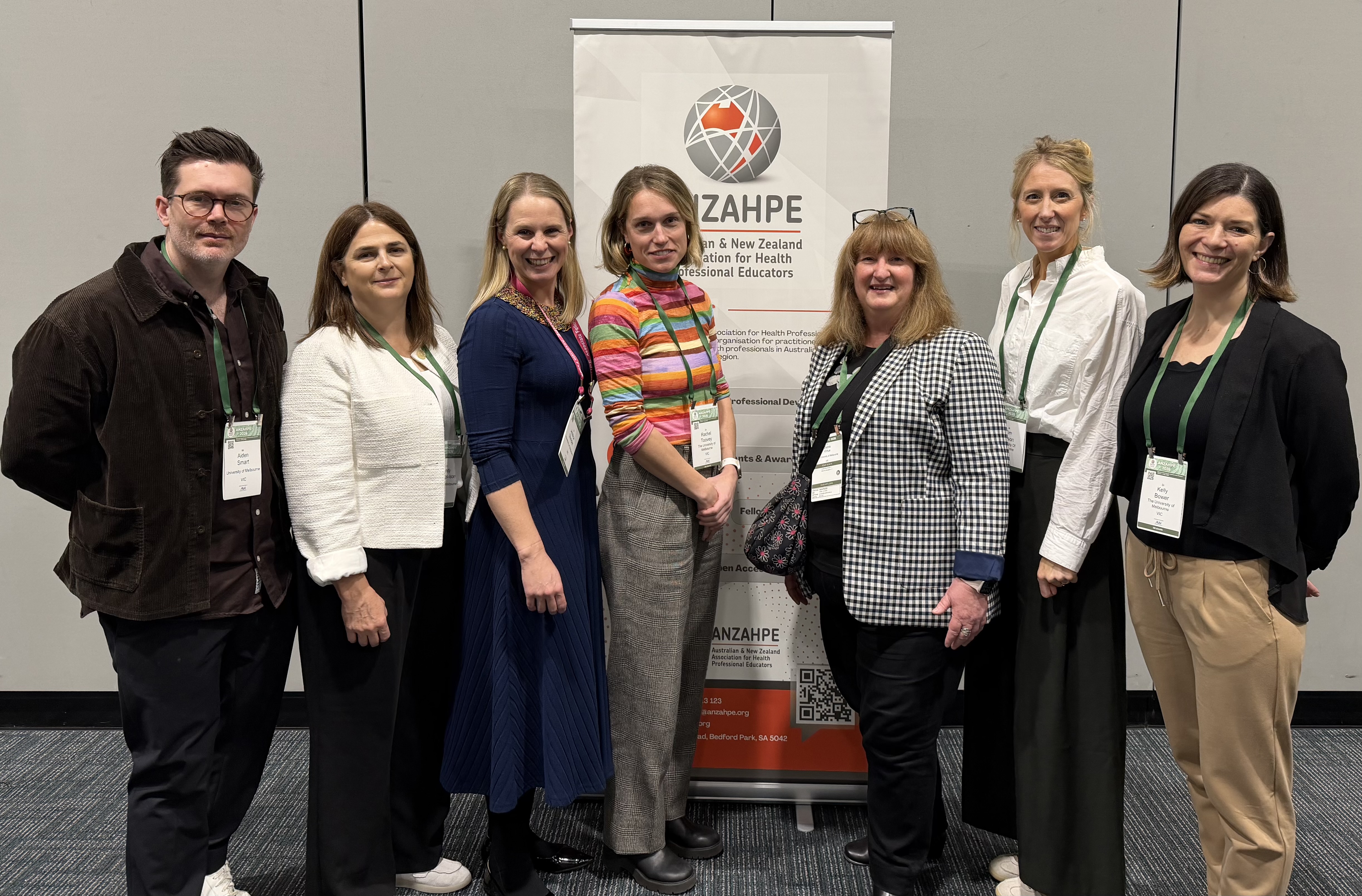
Physiotherapy educators share innovative teaching and learning initiatives at ANZAHPE
ANZAHPE 2026 highlighted innovative approaches to technology-enhanced learning, interprofessional education, clinical education, and AI integration in health professions education.
Jessica Stander showcased an automated individualised feedback system that provided students with detailed, personalised learning insights to support reflection, performance monitoring, and future learning. She also presented a student project evaluating ERiK, an AI-assisted clinical documentation and feedback tool for physiotherapy education, demonstrating improved documentation quality, reduced cognitive load, and strong perceived educational value while emphasising the importance of AI literacy and supervision.
Kelly Bower explored an intergenerational interview program that fostered communication and reflective practice through interactions with older adults.
Rachel Toovey presented a co-designed framework for interprofessional learning in research and evaluation.
Kim Allison demonstrated the use of AI conversational agents as simulated patients and supervisors to support independent practice and subjective assessment skill development.
Tandy Hastings-Ison presented ‘A Fly on the Wall: How online supervision supports development of autonomy in a rural health setting’, showcasing findings from a student capstone project examining how online supervision can support learner independence and professional growth in rural clinical education contexts.
Deb Virtue presented on the development of a novel interactive learning module to better prepare students for the risks of clinical placement – ‘Risk-smart students: weaving risk awareness through health professional education programs’. This foundational module will roll out in 2027 and will be mandatory for all Faculty of Medicine, Dentistry and Health Sciences students prior to their first clinical placement.
Aiden Smart presented on students' experience of near-peer patient actors vs paid professional actors in pre-placement physiotherapy simulations. Students reported both sets of actors were valuable to their learning, with professional actors most useful for developing communication skills while near peers where most effective as improving their technical skills.