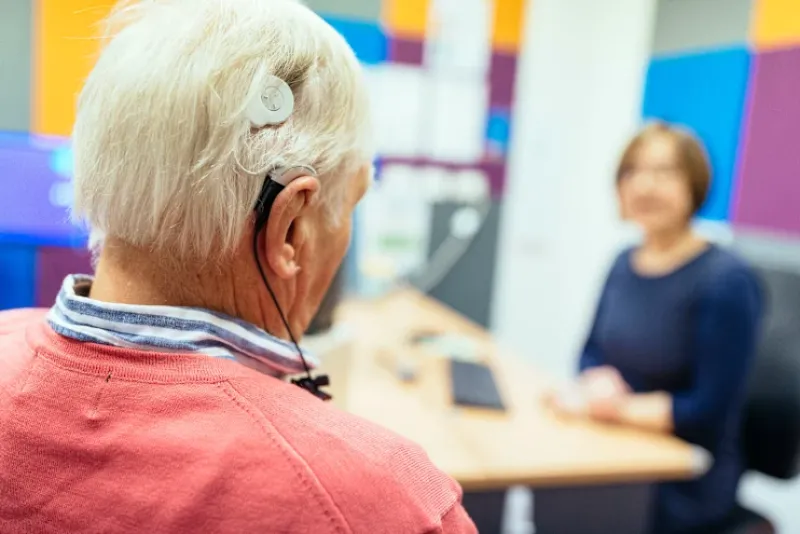
Cochlear implants could improve cognitive function in older adults with hearing loss
Promising results for older adults with severe to profound hearing loss show improved cognitive performance and delay in cognitive decline. A new Cochlear Limited grant will support expanding the study to multiple new international sites.
The Australian COCHLEA (Cochlear Implant Outcomes and Cognitive Health – Longitudinal Evaluation of Adults) study, conducted by the University of Melbourne in collaboration with The Royal Victorian Eye and Ear Hospital, and the Florey Institute of Neuroscience and Mental Health, followed patients eligible for a cochlear implant from before surgery with check-ins at 18 month intervals after cochlear implantation through to 6 years post-surgery.
Professor Julia Sarant, Chief Investigator of the Hearing Loss & Cognition Program and study leader in the Department of Audiology and Speech Pathology and leader of the COCHLEA study at the University of Melbourne, believes the results of this study will inform future public health advice and management of hearing loss to delay cognitive decline in older adults with significant hearing loss.
As part of the process of normal cognitive aging, cognitive performance in older adults (60 years plus) slowly declines. In older adults with untreated hearing loss, this process is accelerated such that they are at greater risk of cognitive decline and dementia. Surprisingly, in the COCHLEA study, on average, participants aged from 60 through to 90 years old with cochlear implants show no evidence of any cognitive decline and instead significantly improved in their outcomes on several cognitive domains for up to 4.5 years post-surgery: https://www.mdpi.com/2076-3425/14/12/1279
In comparison, participants in the Australian Imaging, Biomarkers and Lifestyle Flagship Study of Aging (AIBL) at the Florey Institute of Neuroscience and Mental Health declined as would be expected with normal cognitive aging on some cognitive domains, despite having much better, or normal, hearing.
Fewer than 10% of Australian adults (and fewer than 3% globally) who would benefit from cochlear implants ever receive them, due to factors such as a lack of awareness of this as an option for treating their hearing loss, a lack of knowledge that for most people they are free, and little or no understanding of the life-changing benefits they offer. Fear of surgery is also a barrier.
Given the significant negative effects of untreated severe-profound hearing loss, not only on communication ability but also on physical, mental, and cognitive health, and the exciting results of the COCHLEA study, the study will now be extended to include multiple international sites across developed countries, supported by a grant from Cochlear Limited. This will significantly increase participant numbers and help the study outcomes to be generalisable across the world. The team expects that this new evidence will inform international public policy and hopefully raise awareness of actions older adults can take to support their own healthy aging.