Spotlight on Australian Sign Language (AUSLAN)
Tegan Howell and Erin West from the Department of Audiology and Speech Pathology have had some wonderful success in recent publications and international conferences regarding Australian Sign Language (Auslan).
With very little published about Auslan, it's important to understand the facilitators and barriers to Auslan uptake and use this data to optimally support families who choose to use Auslan with their children who are Deaf and Hard of Hearing (DHH).
Around one in 1000 infants in Australia are diagnosed with significant hearing loss. Significant hearing loss means a loss of around 40 decibels or greater and includes moderate, severe and profound hearing loss. This limits the child’s access to thousands of hours of spoken language models and can lead to language delay and language deprivation. In addition to hearing aids/cochlear implants, and enrolment into early intervention, one course of action is for parents to learn to sign.
Auslan use amongst families of deaf and hard of hearing children
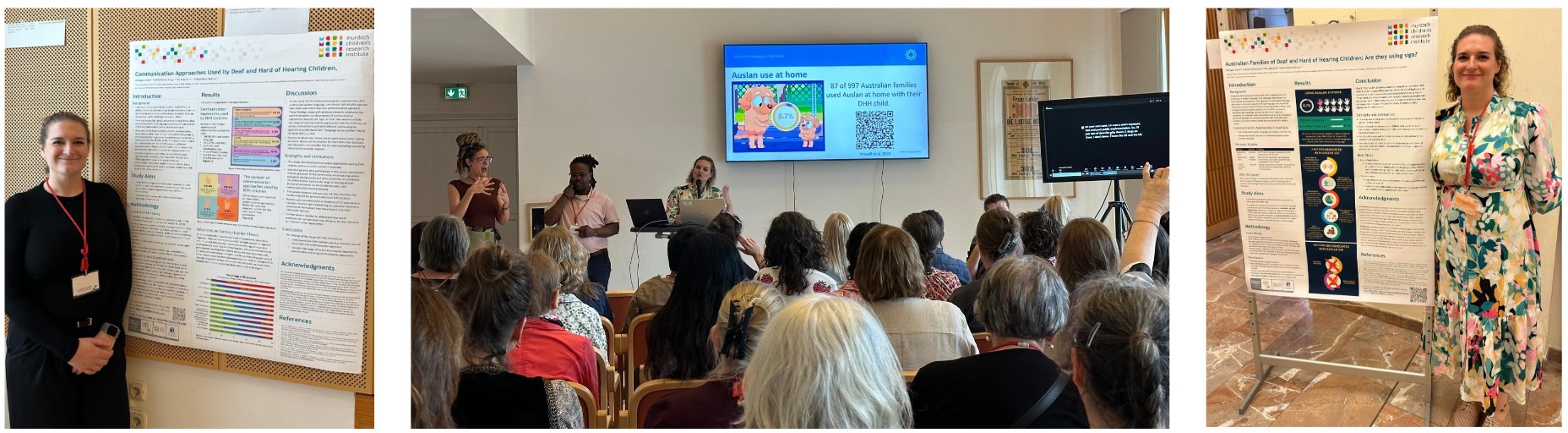
In her survey data from 997 parents of DHH children, Speech Pathologist and MPhil candidate, Tegan Howell showed that only 87 reported using Auslan at home. In a subset of the 87 parents, just 26 reported that Auslan was the primary language for their child. Children using hearing aids and/or cochlear implants with more severe and profound bilateral hearing loss who attended early intervention centres and those with a family history of deafness were more likely to be using sign. These results represent the first step towards understanding factors associated with parental choice of communication approaches for DHH children.
Tegan enjoyed some rapid success when her paper was picked up and cited within a week of publication at an international presentation by A/Prof Wyatt Hall (Deaf Psychologist/Researcher at Rochester and Gallaudet University) who referred to Tegan’s research as “impactful”. Tegan also attended the Family Centred Early Intervention (FCEI) Congress, in Bad Ischl, Austria to present her data (pictured).
Tegan is supervised by A/Prof Shani Dettman, Department of Audiology and Speech Pathology, University of Melbourne and A/Prof Valerie Sung, Paediatrician and Clinician Scientist Fellow, Murdoch Children's Research Institute, The University of Melbourne, The Royal Children's Hospital.
Documenting and analysing Auslan development in children
Looking into the detail regarding Auslan, Speech Pathologist and PhD candidate, Erin West has developed a procedure called the Handshape Analysis Recording Tool (HART) to accurately document a child’s expressive signs. In speech pathology a ‘repository’ is often the first step towards understanding the normal milestones in speech sounds or words used by young children. There is simply no repository for Auslan in existence, and no standardised test to determine if a child under three years of age is acquiring their sign language appropriately. If analysis of signs doesn’t occur until the DHH child is four years old, sensitive periods for language/brain development are missed.
Auslan is not just fingerspelling the alphabet - it is recognised as a rich and fluent language that uses a different word order to English. There are over 38 handshapes that are used to make up words in Auslan. The handshapes are used in different configurations which can be documented in terms of their frequency, accuracy, movement, location and orientation. Erin found that certain handshapes are used more frequently than others in Auslan, and that the frequency and accuracy was quite different to past models proposed for British Sign Language (BSL) and American Sign Language (ASL). That is, we cannot just apply whatever has been written about BSL and ASL to Auslan.
Erin’s HART can be applied by teachers, speech pathologists and researchers for Auslan and other sign languages to create repositories of children’s developing signs.
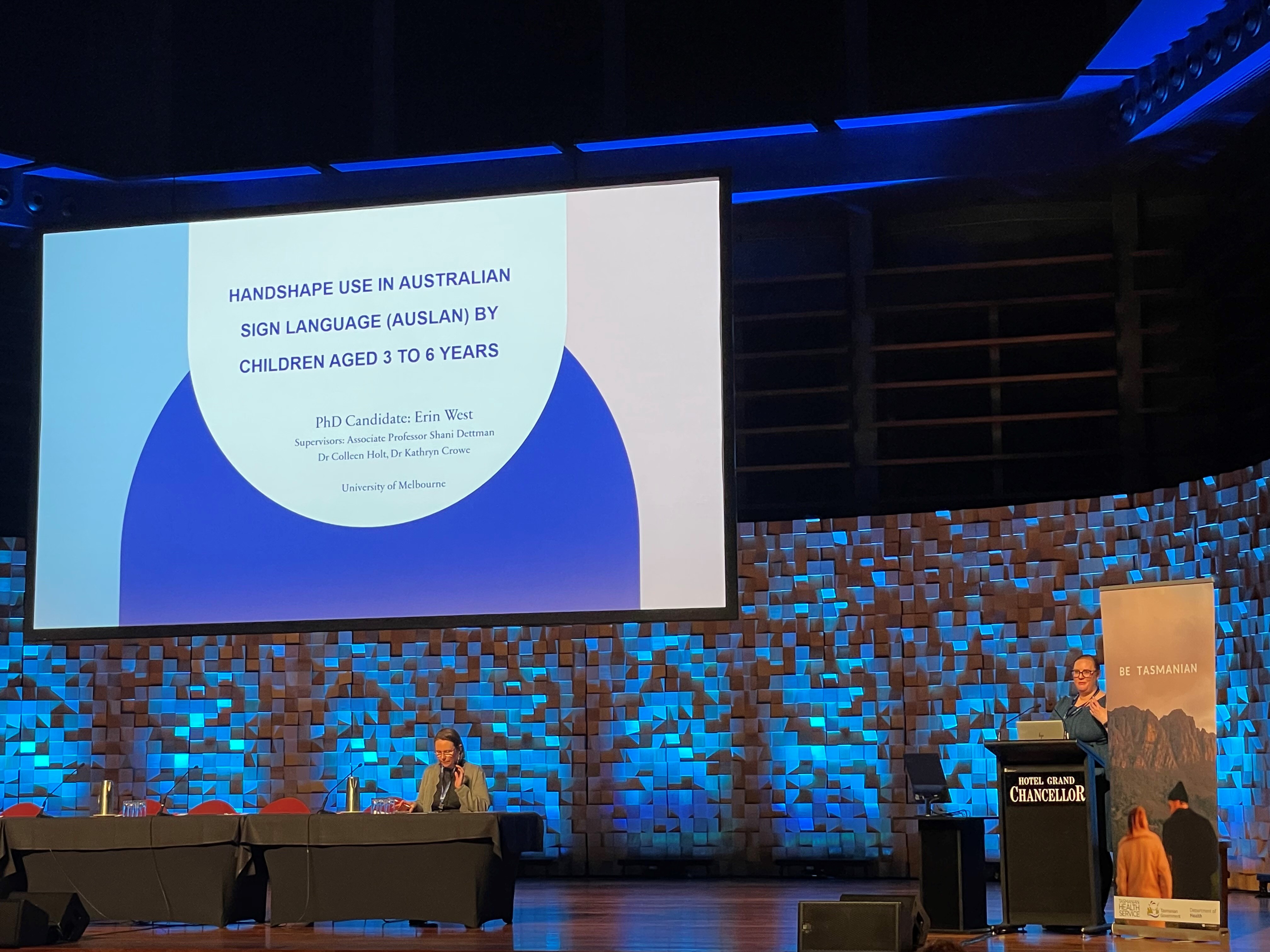
Erin enjoyed disseminating these findings at the recent American Speech Language and Hearing Association Conference (ASHA), in Boston (pictured), and the Speech Pathology Australia Conference, Hobart.
Erin is supervised by A/Prof Shani Dettman, Department of Audiology and Speech Pathology, University of Melbourne and Dr Colleen Holt, Senior Lecturer, Speech Pathology, Department of Community and Clinical Health, La Trobe University.