From Rejection to Resilience: Systematic Review Support
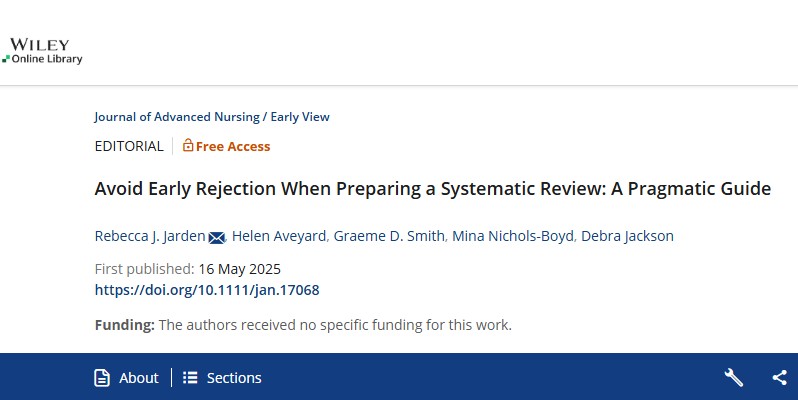
Associate Professor Rebecca Jarden from the Department of Nursing led a team in developing and publishing an open-access editorial: Avoid Early Rejection When Preparing a Systematic Review: A Pragmatic Guide.
Considered the gold standard in evidence-based research, systematic reviews are often one of the most challenging study types to publish. Despite their rigour, they face intense scrutiny during peer review and high rejection rates in top journals. Rebecca’s guide serves as a valuable resource to help fellow academics navigate this process.
Drawing from her extensive experience, A/Prof Jarden reflects on her journey with systematic reviews:
"I wish this editorial had been available when I submitted my first review manuscript 15 years ago, a systematic review focussing on managing gastric residual volumes for people receiving enteral nutrition in critical care."
She candidly shares her initial setback:
"I submitted the review for publication to a highly ranked medical journal and it was knocked back for, what I now know are, easily addressed reasons. At the time, addressing the reasons seemed insurmountable and consequently I didn't revise or resubmit. I still wish I had."
A/Prof Jarden's perspective on systematic reviews evolved during her PhD studies, inspired by a colleague's social media post about article rejection. She explains:
"This post resonated for four reasons, as clinicians we know: 1) the importance of asking questions, 2) the value of high-quality work, 3) documentation and handover are crucial, and 4) a sense of belonging is key. These aspects align with systematic reviews – they're built on important questions, require rigorous methodology, demand persistence in publication and knowledge translation, and remind us that if one journal isn't the right fit, there are always others to consider."
Since her early experiences, A/Prof Jarden has become a prolific author of systematic reviews:
"I have gone on to publish more than 20 reviews, many different types, most as lead or supervising author. My favourites were those that were close to the clinical setting such as those focused on patient falls, nursing students, and early career nurses."
The newly published editorial aims to support other researchers in their systematic review journey. A/Prof Jarden expresses her hopes for the guide:
"It is my hope this editorial will help others in avoiding common pitfalls, persisting with submissions, and ultimately having their own reviews published."
With a touch of humour, she adds:
"I've not yet had one accepted without revisions, but never say never…"