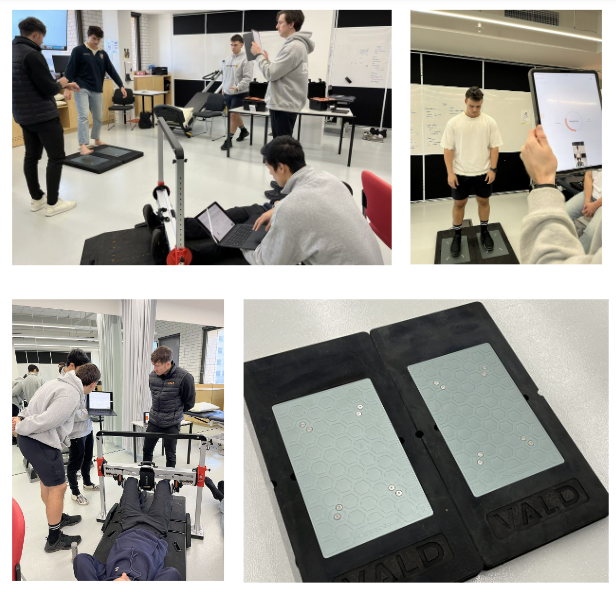
First advanced clinical technology-enabled measurement workshop
He and his team delivered their first advanced clinical technology-enabled measurement workshop with an engaged cohort of final year DPT3 physiotherapy students. Mark is passionate about both embracing innovation to augment healthcare delivery and decision-making, and training the future workforce to thrive in this space; these are skills University students should be learning in the digital age. So alongside industry partners at VALD performance, he created this one-day workshop to bring this vision to life.
Objective assessment is rapidly transforming with the emergence and evolution of novel clinical technologies, revolutionising how physiotherapists evaluate and manage conditions, reflecting the trend in healthcare towards personalised and data-driven decision-making. Whilst traditional assessment methods provide a critical foundation, they are increasingly being complemented and augmented by advanced tools such as force plates, handheld and fixed dynamometers, 3D motion capture, wearable systems and more. For example, force plates offer precise measurements related to balance, force, gait, and postural control, offering objective data that enhance clinical insights. Data we previously didn’t have. Similarly, both hand-held and fixed dynamometry can accurately quantify muscle strength, endurance, fatigue, and rate of force development. These technologies not only improve assessment accuracy but also aid in tracking patient progress over time, and thus provide more tailored and effective treatment plans. Integrating advanced tools into clinical practice helps physios make more informed decisions, ultimately enhancing patient outcomes. Furthermore, technologies support our fundamental principle of evidence-based practice, providing robust data to support clinical judgments.
However, adopting technologies in practice is not without its challenges. Barriers such as cost, the need for more specialised training, and potential resistance to change within the profession can impede their widespread use. Additionally, the interpretation of seemingly complex data generated by these tools requires a deep understanding of both the technology and the underlying metrics. Despite these challenges, there are several facilitators driving the integration of clinical technology in physiotherapy. Continued technological advancements are making these tools more accessible, portable, and user-friendly. Further, increasing awareness of their benefits among practitioners, students, and patients alike is fostering a positive attitude towards their adoption.