Alumni story: Nikolia Locke
How studying audiology helped a musician find a new way to connect with people
A firsthand encounter with the challenges of hearing loss inspired Nikolia Locke to transition from an undergraduate music degree to a career in audiology.
Now completing her clinical internship across two roles at the University of Melbourne, Nikolia reflects on how the Master of Clinical Audiology helped her connect a lifelong passion with a calling to make a difference.
From the conservatorium to the clinic
Before enrolling in the Master of Clinical Audiology, Nikolia completed a Bachelor of Music (Performance) at the University of Melbourne. “During my studies, I became increasingly interested in hearing and hearing conservation,” she recalls.
Nikolia’s personal experience seeing the positive impact of audiology helped motivate her change in direction. “Growing up with family members affected by hearing loss, I have seen how audiology can help people stay connected with their loved ones and continue doing the things they enjoy,” she says. “This inspired me to pursue a career where I could make a meaningful difference to people’s quality of life.”
Nikolia was drawn to the Master of Clinical Audiology’s balance between theory and hands-on clinical experience. “It covered such a range of areas of audiology, from basic hearing tests to complex vestibular disorders, while also providing opportunities to work with patients in a range of clinical settings.”
Having the Melbourne Hearing Care Clinic – one of the largest university-based audiology clinics in Australia – on campus was another major drawcard. “It meant I had access to extensive clinical training across a broad range of audiology services throughout the course.”
A supportive transition into healthcare
Coming from a non-science background, Nikolia admits she wasn't sure how she'd cope early on. “I was initially nervous about whether I would be able to keep up,” she says. “However, those concerns were soon eased once I experienced how well the course was structured. The content was delivered in a way that was accessible regardless of your undergraduate background.”
The calibre of teaching left a lasting impression. “The lecturers and academic staff brought a high level of expertise and clinical experience to their teaching,” she says. “Their knowledge and enthusiasm for audiology created a sense of confidence and trust in the information we were learning. I always felt comfortable asking questions, knowing they would be met with thoughtful and evidence-based answers.”
The support that Nikolia received from academics was underpinned by a close-knit student community. “With a relatively small cohort, you quickly get to know your peers and form strong friendships, creating a collaborative environment where everyone was encouraged to learn and support one another,” she says.
She also made the most of opportunities outside the classroom by getting involved with student clubs and societies, volunteering and hearing health events. “These experiences allowed me to meet people across different year levels, engage with the broader audiology community and explore different aspects of the profession beyond the coursework.”
Clinical experience on the other side of the world
Clinical placements and weekly practical classes have been a highlight of Nikolia’s student experience. “These experiences gave me the confidence to apply my knowledge in real clinical settings. It also gave me the opportunity to develop strong communication skills and the ability to build rapport with patients from diverse backgrounds.”
In addition to a range of local placements, throughout Nikolia’s degree she completed two overseas placements. The first of these was a two-week placement at a student-run hospital in India working alongside speech pathology and physiotherapy students. “This was a valuable opportunity to learn from other disciplines and see how audiology is practised in a different healthcare setting,” she says.
The second took her to Canada for a four-week paediatric placement. “Attending this placement independently helped me build confidence in my clinical skills and gain experience working with children with a range of abilities and additional needs.”
“These experiences have shaped the way I approach my clinical roles today, helping me become a more adaptable and confident clinician.”
A full-circle moment
For Nikolia, the shift from performing arts to healthcare has paid off.
“My background in music has often helped me connect with patients and better understand their experiences with hearing loss,” she says. “A proud moment for me was returning to the Melbourne Conservatorium of Music as part of my final year thesis to assess the hearing of undergraduate music students. This felt like a full-circle moment and it was incredibly rewarding to give back to a community that had been such an important part of my life.”
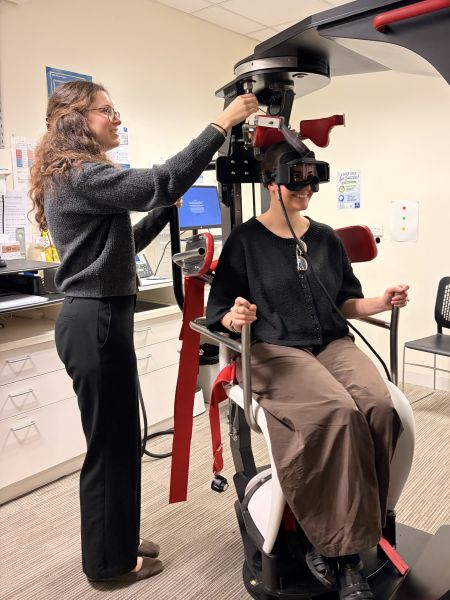
Nikolia is now completing her clinical internship across two roles. “As a Research Assistant at the University of Melbourne, I work on the ENHANCE study, which investigates the relationship between hearing loss, hearing aid use, and cognitive function,” she explains. “I also work at the Melbourne Hearing Care Clinic as a vestibular and diagnostic audiologist.”
“What inspires me most is seeing the meaningful impact that hearing care can have on people's lives. Throughout my studies I have been inspired by the patients, clinicians, and educators I have met, who have reinforced the importance of empathy, curiosity, and lifelong learning in this profession.”